
In the fast-evolving world of Web3 gaming, staking rewards have become one of the most adopted and misunderstood mechanics. Often introduced with the promise of “free tokens” and sticky user engagement, staking has both empowered ecosystems and, at times, threatened their very foundation.
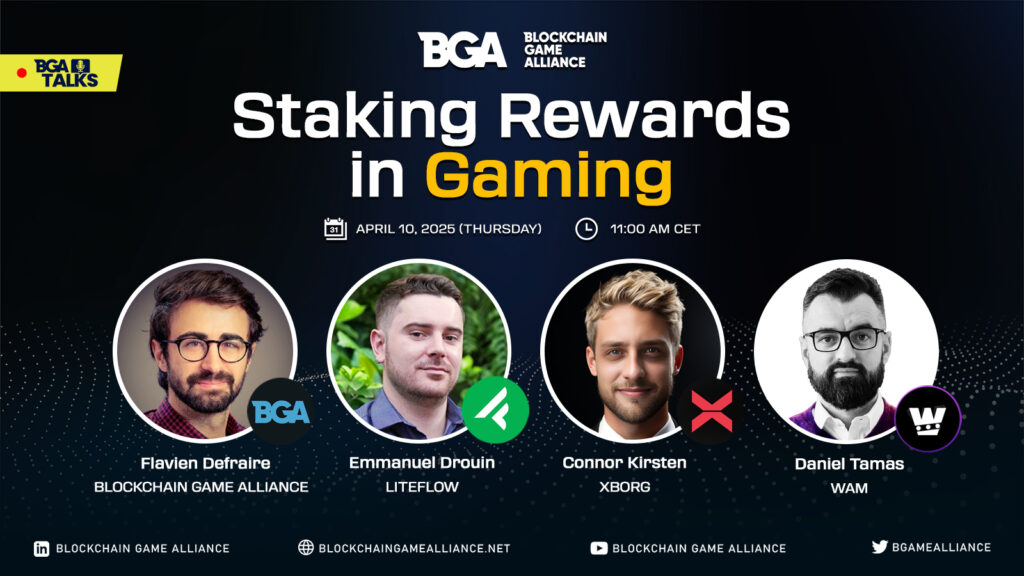
To unpack this complex topic, I had the pleasure of moderating a Blockchain Game Alliance panel featuring Emmanuel, COO & Co Founder from Liteflow, Connor, Growth & Marketing Manager at Xborg, and Daniel Tamas, Co Founder at WAM. Each brought a unique perspective rooted in hands-on experience designing staking systems for their communities and partners. What followed was an honest and insightful exchange about what works, what hurts, and what’s next.
The Origin of the Misconception
Many game studios entering Web3 today still carry the baggage of the 2021–2022 “Play-to-Earn” era. As Emmanuel pointed out, this period created a widespread assumption: if you’re building a Web3 game, you must have a token, and if you have a token, you must offer staking.
But as countless projects have since discovered, launching a token too early, and tying staking to inflationary rewards—often leads to unsustainable economies. Instead of long-term engagement, you get short-term value extraction and a race to the bottom in token price.
Staking as a Value Extractor vs Value Amplifier
The conversation quickly zoomed in on one fundamental question: Is staking extracting value from your ecosystem or reinforcing it?
Dani, who launched WAM’s token in 2021, shared a cautionary tale. Following the prevailing advice, they introduced high APR staking, only to see it cannibalize their token economy.
“You’re basically kicking your project right in the private parts,” […] “Staking should not be a treasury drain—it should be tied to real, operational revenue.”
He emphasized a shift: staking must move from being a mechanism for inflation to a function of circularity. Reward pools, ideally, should be fueled by actual revenue streams, such as smart contract fees or ad revenue, not by unsustainable emissions.
Connor’s perspective from Xborg echoed this. Their staking system isn’t even called staking—it’s pledging. Tokens aren’t locked; they’re simply held, signaling conviction. In return, users earn tiered rewards, which can be boosted by completing quests, participating in governance, or holding NFTs. This dynamic system has proven to deepen community engagement without turning the token into a short-term farming tool.
Gamifying the Commitment
A powerful idea emerged: staking doesn’t need to feel like DeFi. Instead of being a yield-chasing tool, it can be gamified to support identity, social status, and player progression.
Connor explained how Xborg’s community staking is built around loyalty and presence, not speculation. A good example is their collaboration with Team Liquid: Xborg holders could unlock exclusive wearables in the Team Liquid app that boosted staking rewards—a cross-community activation with real gameplay impact.
Emmanuel pushed the idea further: what if staking wasn’t financial at all? What if it became the foundation for crafting systems in games? “Staking is essentially locking value for a reward,” he explained. “In RPGs, that’s crafting. Why not put it on-chain?” In this lens, staking becomes a core gameplay mechanic—not a spreadsheet simulator.
Designing for Players, Not Investors
Throughout the session, one theme kept returning: Know who your users are. Are they players or investors? Trying to be both often leads to chaos.
If your game economy relies on players acting like DeFi farmers, you’re building for the wrong motivations. If your staking program turns the game into a passive yield generator, you shift attention from gameplay to price charts. “You’re not building a game anymore,” Emmanuel reminded us. “You’re building a financial instrument.”
Instead, staking should serve the game, the lore, the community, and yes, the partners too.
Staking as a Bridge Between Ecosystems
Both Connor and Dani discussed how staking systems can foster partnerships. In Xborg’s case, partners like Team Liquid integrate into the staking journey through exclusive content and quests. WAM plans to do the same, tying staking rewards to cross-platform engagement and ad revenue sharing.
This opens up the potential for staking to be more than internal retention—it can become a vehicle for network effect, cross-promotions, and community-driven growth.
The Question of Rewards: How Much and From Where?
Staking often falters not in design but in economics. The panel agreed: if your rewards come from the treasury, you’re on borrowed time.
Dani offered a concrete example: WAM’s upcoming swap product will distribute transaction fees across tournaments, staking pools, and operational costs. “It’s a virtuous loop,” he said. “More users, more revenue, more staking rewards.”
This model, where staking rewards are transparently tied to real usage, creates an alignment between player behavior and project sustainability.
Timing is Everything
Finally, we touched on timing—an often-overlooked factor. Launching staking in the wrong market cycle or too early in your game’s development can lead to disastrous outcomes.
Connor shared that Xborg waited until after building a loyal community to launch their token and structured it to survive sell-offs and reward belief. “We only raised from our community,” he said. “We knew there would be volatility. So we made sure those who stuck around would be rewarded.”
Timing isn’t just about bull or bear markets. It’s about readiness, alignment, and community trust.
Final Thoughts
Staking rewards aren’t going away—but they must evolve.
They are not magic tools to fix retention or pump tokens. When misused, they break games, dilute communities, and destroy trust. But when designed with intention and grounded in gameplay, powered by revenue, and aligned with user values, they can unlock powerful loops of engagement and cooperation.
As Web3 gaming matures, the question is no longer “should we do staking?” but “how can staking serve our game and players better?”
The answer lies not in copying what worked in 2021, but in listening to players, partners, and your own long-term vision.