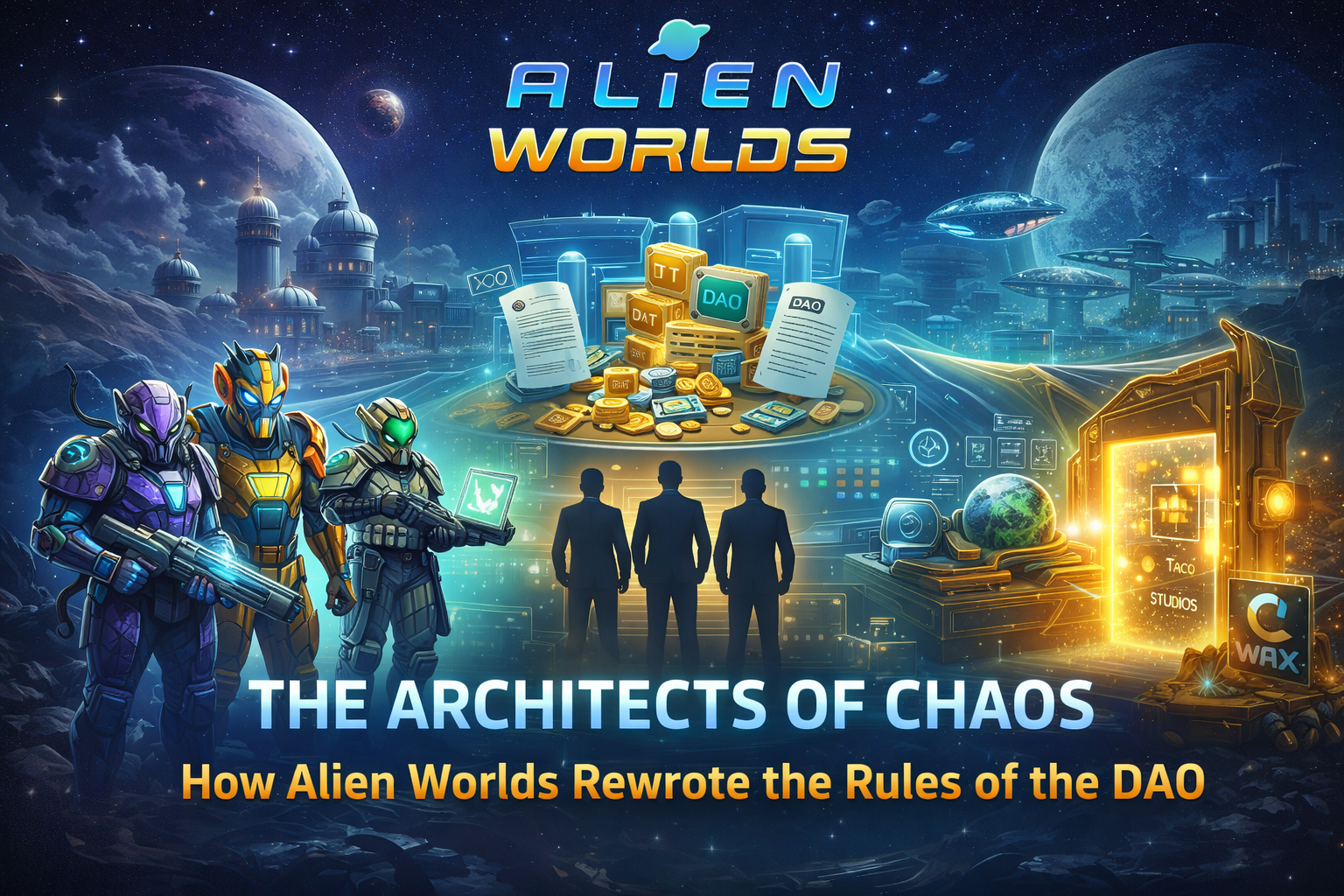
The Architects of Chaos: How Alien Worlds Rewrote the Rules of the DAO
For years, the technology sector was intoxicated by the promise of the Decentralized Autonomous Organization, or DAO. The pitch was revolutionary: entities run by code and community consensus rather than boardrooms and CEOs. However, as the initial euphoria of the blockchain boom subsided, a stark reality emerged. The landscape was littered with organizations paralyzed by voter apathy, directionless governance, and an inability to ship actual products. Amidst this graveyard of good intentions, Alien Worlds has quietly charted a different course. By pivoting away from the abstract ideal of “governance” and toward a tangible model of incentivized creation, they have effectively vouched for the DAO not as a political experiment, but as a sustainable production engine.
The core of the Alien Worlds philosophy lies in a recognition that a community needs more than just voting rights; it needs a shared history. In the early days, developers were building isolated projects without a unifying thread. To solve this, the team didn’t just write a rulebook; they hired sci-fi author Kevin J. Anderson to craft a foundational “lore”. This wasn’t merely flavor text—it was a strategic “North Star.” By providing a canonical blank canvas, they allowed the community to expand the universe rather than just consume it. The results argue for themselves: a staggering 1.1 million words of lore have been generated by AI and community writers, with hundreds of users submitting content validated by millions of Trillium (TLM) votes.
However, a shared story is not enough to keep the lights on. Alien Worlds identified that the fatal flaw in most DAOs is a reliance on volunteerism, which inevitably leads to burnout or dominance by a wealthy “Old Guard”. To vouch for the viability of a DAO, Alien Worlds professionalized the contributor. Through the Galactic Hubs grant program, they shifted the paradigm from passion projects to paid work. This system allows newcomers to “get their feet wet” with smaller grants, eventually graduating to complex developments. It has spawned a “mini-worker system” where writers and developers are headhunted by studios within the ecosystem to craft narratives for titles like Starblind, Mission Control, and Meta Battler.
This economic engine is reinforced by a governance structure designed specifically to combat the volatility inherent in crypto. Alien Worlds circumvented the traditional single-DAO risk by establishing multiple specialized DAO layers that run parallel to the main governance. These include:
- Lore DAO: Focused on canonical storytelling and community-validated content.
- Planetary Syndicates (or the six Planetary DAOs): Responsible for guiding planetary development and setting priorities.
- Union DAOs: Providing a worker proposal system for longer-term initiatives, complete with a designated arbiter to step in if needed.
This pragmatic, multi-layered approach ensures stability, allowing developers to commit to ambitious roadmaps for next-generation titles like Alien Legends and Siege Worlds without the looming fear of political instability.
This higher level of governance though manifests primarily through the role of the Planetary Custodians. These are not merely accountants rubber-stamping invoices; they operate as distinct, specialized cabinets for each of the six Planetary Syndicates. By decoupling these bodies from the volatility of general elections, Alien Worlds has created a layer of “middle management” that shields long-term projects from the chaos of the mob. This structure ensures that when a developer commits to a six-to-nine-month roadmap for a complex title like Alien Legends or Siege Worlds, they are dealing with a stable executive partner rather than a fickle crowd.
However, the most striking evidence of this “command” maturity is the DAO’s ability to execute complex foreign policy. In the digital nation-state, “foreign policy” is interoperability, and Alien Worlds is aggressively expanding its borders. The Galactic Hubs program acts as the diplomatic arm of this government, negotiating cross-chain alliances that no disorganized collective could manage.
A prime example of this diplomatic reach is the recent treaty with Taco Studios on the Taiko blockchain. This isn’t just a simple token swap; it is a full-scale cultural integration where the Alien Worlds “government” has successfully exported its citizens—specifically the refugee character Xenoth Vargian—into a completely different sovereignty, the pixel-art game Brigade. This required high-level coordination: setting up technical bridges for “burning” Alien Worlds NFTs on the WAX blockchain to trigger asset releases on an EVM-compatible chain. This serves as a masterclass in digital governance: the DAO is leveraging its assets to colonize new markets, requiring players to hold dual citizenship (wallets on both WAX and Taiko) to participate
Ultimately, Alien Worlds understands that a DAO cannot survive on ideology alone. Ben McGowan of the Alien Worlds team notes an exciting shift in community psychology: while financial incentives started the engine, the “tokenized lore” has taken hold, and creators are now prioritizing content that enriches the canon over simple cash grabs. By providing the tools, funds, and stability to build, Alien Worlds has moved beyond the hype, offering a blueprint where the DAO serves not just as a bank, but as a validation layer for a living, breathing digital civilization.

Recent Posts