
Beyond the AI Slop: How 404 and Atlas Are Building the Decentralized Assembly Line for 3D Game Assets
For a long time, bridging generative AI and decentralized blockchain networks felt more theoretical than practical. We all recognized the inherent potential of both tech stacks, but finding a practical overlap that genuinely serves game creators (without compromising artistic integrity) was a puzzle the industry was still solving.
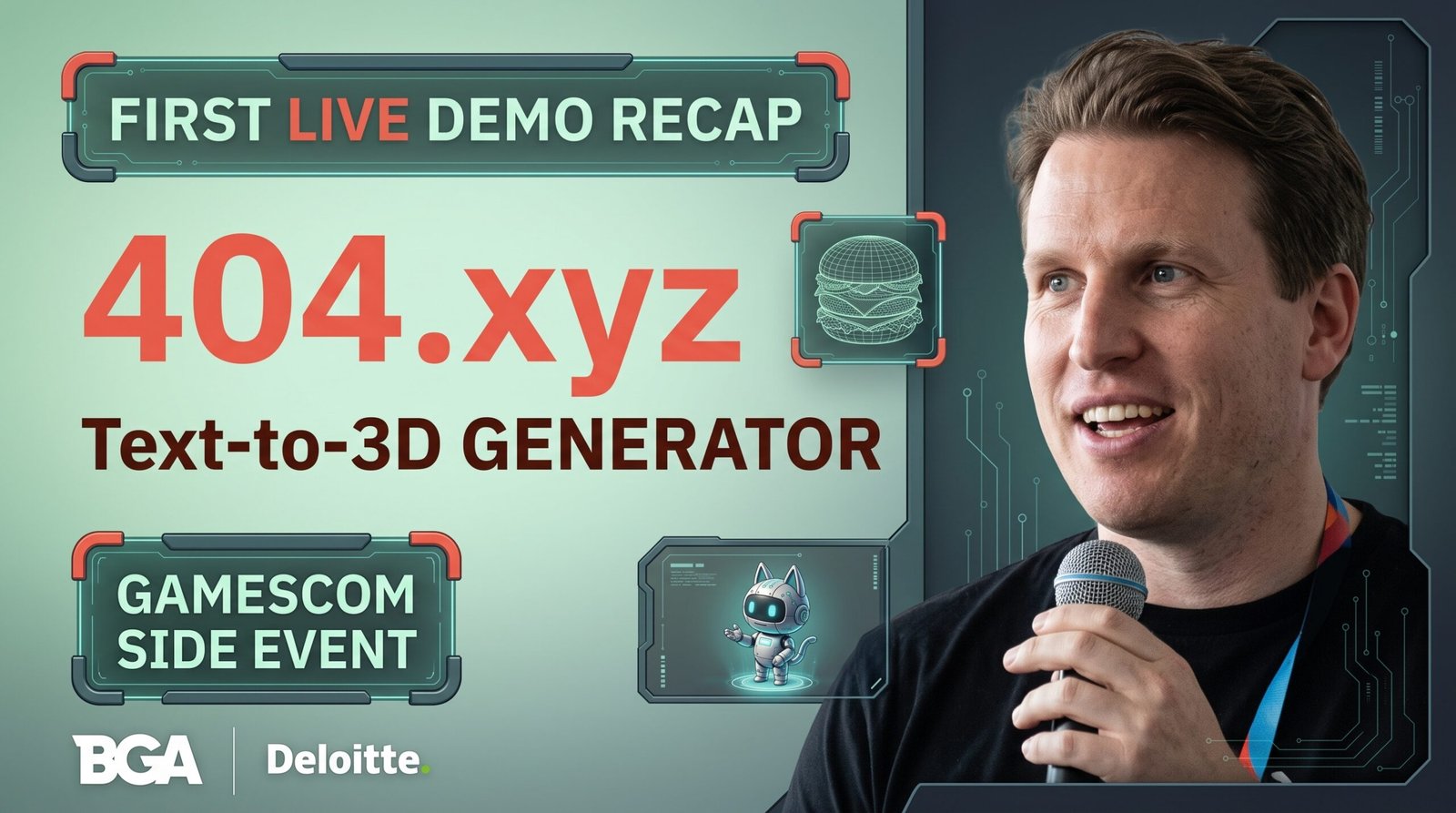
Sitting at our BGA side event “Agentic AI Summit” during Gamescom in Cologne, watching Robin Simons demo what 404.xyz and Atlas are building, that puzzle fell into place.
We aren’t looking at generic asset-generation gimmicks. We are witnessing a grounded Gaming Evolution; one that respects the artist’s craft, honors a studio’s visual identity, and leverages decentralized compute to solve engine-level bottlenecks. Here are the core operational takeaways on how this hybrid infrastructure is coming to life.
1. Decentralized Compute vs. The Black-Box Monopoly
At the infrastructure level sits 404.xyz. Instead of trying to lock developers into a proprietary, expensive black-box model, 404 functions as a decentralized compute network optimized for image-to-3D generation.
The reality of raw open-source 3D AI models is ugly: mesh tearing, random surface holes, and corrupted UV island mapping. Rather than building a closed system, 404 sets up competitive subnets where independent miners are incentivized to solve these exact structural bugs.
By crowd-sourcing optimization through decentralized subnets, they clean up open-source models without degrading asset quality. It gives developers high-speed 3D generation without forcing founders to surrender control or data to a single centralized provider, securing long-term Founders’ Trust.
2. Killing the Chatbox: Putting Artists Back in the Driver’s Seat
If you force a senior concept artist to interface with generative tools through a generic text box, you degrade their trade. Text prompts breed stylistic drift. The fast track to diluted branding and public backlash.
Atlas acts as the application and orchestration layer to fix this, offering a node-based canvas that speaks the visual language technical artists already use.
- Art Bible Integration: Drop a studio’s 50-page visual direction PDF directly onto the canvas.
- Agent Orchestration: An integrated agent reads the document, maps out the node pipeline, enriches prompts, and automatically pulls faction-specific style rules.
- Deterministic Control: Artists tweak individual node parameters or swap underlying AI models, keeping full authority over every step of the generation process.
3. The Live API Assembly Line: From Art Bible to Unity Mesh
The real test of tech isn’t how pretty it looks in a sandbox demo; it’s whether it survives live runtime. Robin showcased a pipeline powering a soft-launched mobile game where generated assets are injected directly into Unity on the fly.
When a player crafts an item, the backend executes a clean, multi-step pipeline:
- Prompt & Asset Generation: Generates the initial 2D asset based on faction rules, then converts it to 3D via 404’s fast-running model (completing under 30 seconds).
- Automated Remeshing: Automatically decimates high-polygon outputs into optimized, mobile-ready meshes so phone GPUs don’t melt.
- Bounding Box Standardization: Standardizes origin points and bounding boxes automatically so helmets fit character skeletons perfectly out of the box.
- Failover Redundancy: Employs fallback nodes if a primary model drops, ensuring zero failed generations for the end player.
They’ve even solved persistent edge cases like dynamic AI rigging—generating functional finger geometry that connects cleanly into standard Mixamo animation libraries.
Bottom Line
Generative tools won’t replace human art direction, but lazy implementations will drain a studio’s runway and alienate players. The path forward isn’t chasing text-prompt gimmicks—it’s building deterministic, artist-led workflows backed by decentralized infrastructure. When you put technical artists in charge of node graphs and decentralized networks in charge of heavy compute, you deliver real Proof of Presence and lasting value to The Cultural Layer of gaming.
Watch the full video below and let’s keep building.

Tags
Recent Posts

Senior QA at DeGaming
Product Owner at DeGaming