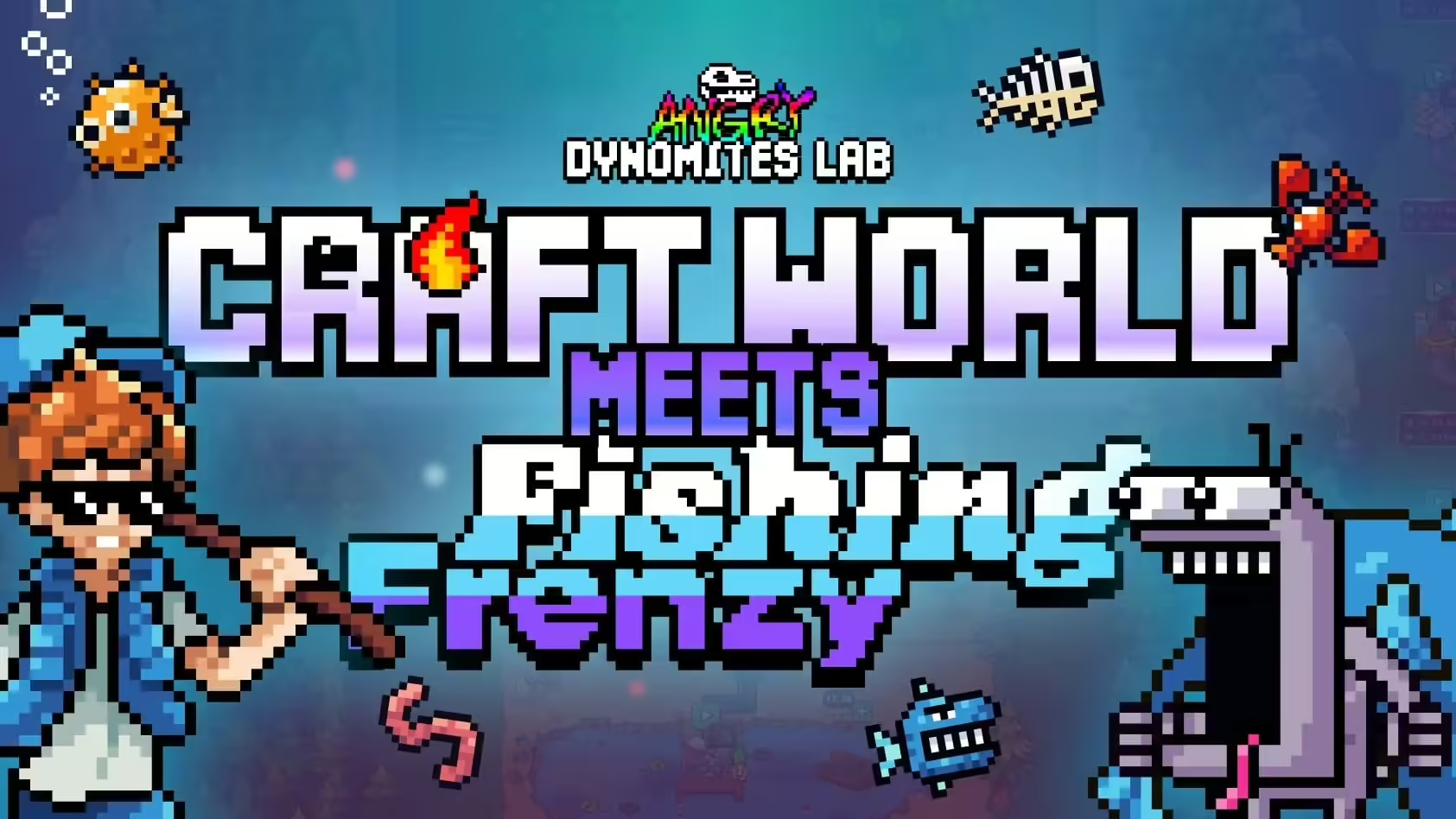
The Angry Dynomites x Fishing Frenzy Collaboration
The gaming industry often theorizes about the potential of “interoperability” ; the ability for assets and currencies to move seamlessly between different game worlds. This case study analyzes the live collaboration between Angry Dynomites (specifically their Craft World mode) and Fishing Frenzy. Both titles utilize the Ronin blockchain to demonstrate how cross-game token utility can drive user acquisition, monetization, and economic volume.
The data confirms that blockchain integration delivers tangible Key Performance Indicators (KPIs), generating over $300,000 in trading volume and attracting 15,000 paying participants during a single event.
1. The Opportunity: True Asset Interoperability
In traditional gaming, in-game currency is usually siloed within a single title. This collaboration sought to disrupt that model by allowing the native token of one game (Fishing Frenzy) to function as a critical resource in another (Angry Dynomites).
The Mechanics:
• Token Integration: Players of Craft World (an Angry Dynomites game mode) were able to import $FISH, the native token of Fishing Frenzy.
• Utility: Within Craft World, $FISH was not just a speculative asset; it was a functional utility token used to purchase “worms,” the foundational resource required to start the event’s production loop.
• Seamless Exchange: Players could acquire $FISH directly using “Dinocoin” (the Craft World currency), demonstrating a seamless swap of value between two distinct gaming ecosystems on the Ronin blockchain
2. Performance Metrics (KPIs)
The integration of blockchain technology translated into high-value engagement metrics that traditional user acquisition strategies often struggle to match. The collaboration resulted in Angry Dynomites’ “biggest event yet”
Key Financial & Engagement Stats:
• Economic Velocity: The event generated $300,000 USD in trading volume for in-game resources.
• Monetization: There were 15,000 paying event participants.
• Cross-Pollination: Users imported 20 million $FISH tokens (valued at approximately $57,000) into the Craft World ecosystem.
• User Growth: New installs peaked at 1,100 per day during the collaboration.
These figures illustrate that blockchain mechanics can drive significant liquidity and paying user conversion rates.
3. Technical Architecture & User Experience
The collaboration leveraged the Ronin blockchain to ensure transparency and asset ownership.
• On-Chain Resources: All resources in Craft World function as ERC20 tokens. This means items like “worms,” “fish,” and “bone soup” are not just database entries but actual blockchain elements,.
• Dynamic Prize Pools: As players spent $FISH to buy worms, that spent token revenue was redirected into a prize pool. This created a circular economy where player participation directly incentivized the reward structure
4. Balancing “Play-to-Earn” with Fair Play
A common criticism of blockchain gaming is that “whales” (high spenders) dominate the economy. This collaboration implemented specific design choices to ensure gameplay retention over simple pay-to-win mechanics.
• Forced Gameplay Loops: The developers restricted the ability to simply convert resources instantly via the “Masterpiece” leaderboard. Instead, they forced players to engage with the game mechanics (creating resources through time-based clicks) rather than just buying their way to the top.
• Level Playing Field: By preventing the automated conversion of materials, the developers ensured a more equitable environment where “power players” could not simply scoop up all rewards without spending time in the game
Conclusion
The Angry Dynomites x Fishing Frenzy event serves as a proof-of-concept for the benefits of blockchain in gaming. By enabling permissionless interoperability—where a token from Game A drives the economy of Game B—developers can unlock new revenue streams and user bases.
The resulting $300k trading volume and 15k paying users provide hard evidence that Web3 technologies, when applied to engaging game loops, deliver superior KPIs compared to siloed Web2 economies.