
How Parallel’s Colony Is Turning Agentic AI into Actual Gameplay
It’s good to be back in Cologne for Gamescom 2026. Despite the brutal headwinds facing the industry right now, walking the floor reminds you why we’re all here, the sheer enthusiasm for gaming is as loud as ever.
While AI was certainly a talking point across the convention center, most of it was relegated to back-office optimizations or cost-cutting tools. But over at our BGA Agentic AI Summit : the only event during Gamescom dedicated specifically to agentic AI, we wanted to cut through the noise. We were looking for technology that doesn’t just cut developer bills, but actively enriches the player experience.
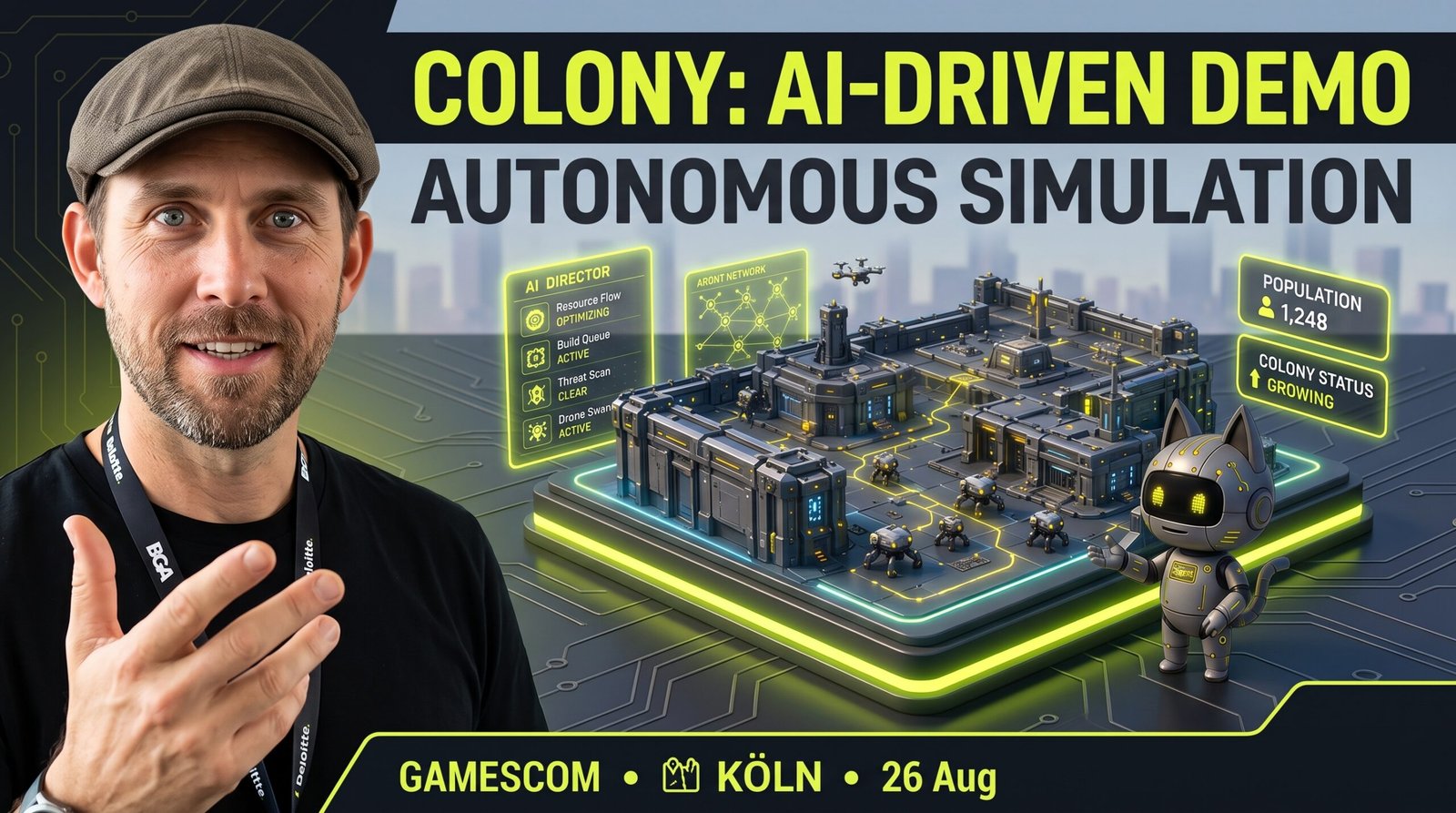
Parallel, one of the few studios that navigated the Web3 winter and kept shipping, walked onto our stage to showcase Colony. What they demonstrated was a masterclass in how to turn agentic AI into the core mechanical engine of a game.
Here are the pragmatics from their demo and why it represents a genuine Gaming Evolution.
Beyond the Toll Road: AI for Players, Not Just Pipelines
Most studio heads look at LLMs like a toll road: a way to pay less and speed up production pipelines. But cutting art budgets doesn’t build Founders’ Trust, and it certainly doesn’t make a game more fun to play.
Parallel flipped the script. Instead of asking how AI could accelerate asset pipelines, they asked: How can we put LLMs inside the product to enhance player agency? Taking a 4X strategy framework (resource gathering, colony management, event survival), they integrated agentic AI directly into the loop. The AI isn’t an efficiency tool for the developer; it’s an interactive companion and dynamic world-builder for the player.
Frictionless UX: Beyond 1980s Text Parsers
Early AI implementations in games often fall into a trap: slapping a raw text chat box over existing mechanics. Parallel tried this early on, making players prompt characters with basic commands like “climb tree” or “pick up rock.”
It was clunky. Point-and-click replaced text parsers thirty years ago for a reason. Tacking raw text input onto modern mobile interfaces makes zero sense.
Parallel pivoted by weaving AI into intuitive, branching narrative choices. When an emergency strikes your colony (like the reactor core freezing over) you don’t just click a generic “Repair” button. You converse with an AI engineer named Skipjack. If you decide to solve the freeze by knitting a giant wool scarf for the pipes or deploying blowtorch micro-robots, the AI processes your custom logic, generates the outcome, and seamlessly incorporates it into the game state.
Proof of Presence: Evolving Personalities and Memories
Static NPCs are officially a relic of the past. In Colony, player characters are AI agents built on top of a pool of over 11,000 handcrafted visual assets, but their true identity comes from their personality prompt.
Players can shape their agent’s behavioral logic. Give your character the persona of a mime, and instead of a basic log entry like “I opened the door,” the game text-generates: [Your character mimes walking to a door and trying the handle]. Crucially, these agents remember past events, victories, and colony blunders. They evolve over time alongside the player, creating a genuine Proof of Presence within The Cultural Layer of the game world.
From Prompts to Polygons: Real-Time In-Game 3D Generation
The climax of the demo came when Parallel, partnering with Atlas Design, ran a live text-to-3D test directly on stage.
An audience member shouted out a prompt: “A purple helmet with bunny ears and a mohawk.” The presenter typed it into his phone. Within five minutes, the system generated not a 2D concept drawing, but a fully textured, game-ready 3D asset, rigged and equipped directly onto the player’s character across all screens.
We are watching the end of static, developer-bottlenecked cosmetics. Players are moving from passive consumers to active co-creators. If a player wants a cyberpunk samurai mask topped with a miniature volcano, they can prompt it into existence in minutes.
Bottom Line
We don’t need more pitch decks promising “disruption.” We need playable proof. What Parallel demonstrated in Cologne shows that when you stop treating AI as a cost-cutting shortcut for the studio and start building around player agency, you create entirely new ways to play. The technology is still maturing, but the direction is clear: the next era of gaming belongs to worlds we build with our players, not just for them.
Let’s keep building.

Tags
Recent Posts

Senior QA at DeGaming
Product Owner at DeGaming