In the rapidly evolving landscape where gaming meets blockchain, the Base platform has emerged as a crucial testing ground for new economic and design models, seeking to overcome the traditional Lifetime Value (LTV) constraints of the Web2 “hybrid casual” genre. In this exclusive interview, we sit down with John Hyukshin CHO, Head of Web3 Gaming at Grampus, who is pioneering a shift from single-game economies to an interconnected model by leveraging on-chain assets.
You mentioned that because LTV is a constraint in hybrid casual games, it’s crucial to plan how one game grows into the next. With Chef Universe, are you designing the on-chain assets (like the ingredients or burgers collected in Rolling Burger) to be transferable? Will a player’s progress in the first game explicitly unlock value or status in the second, creating a ‘Universe’ LTV rather than a single-game LTV?
In Web2, hybrid casual games carved out a strong space between hyper casual and mid core, but over time live ops became a real burden. Sustaining LTV often depends on a constant cycle of content updates and events. We see Web3 as a way to approach this differently, by letting value created in one game extend beyond that single title instead of relying entirely on in game live ops.
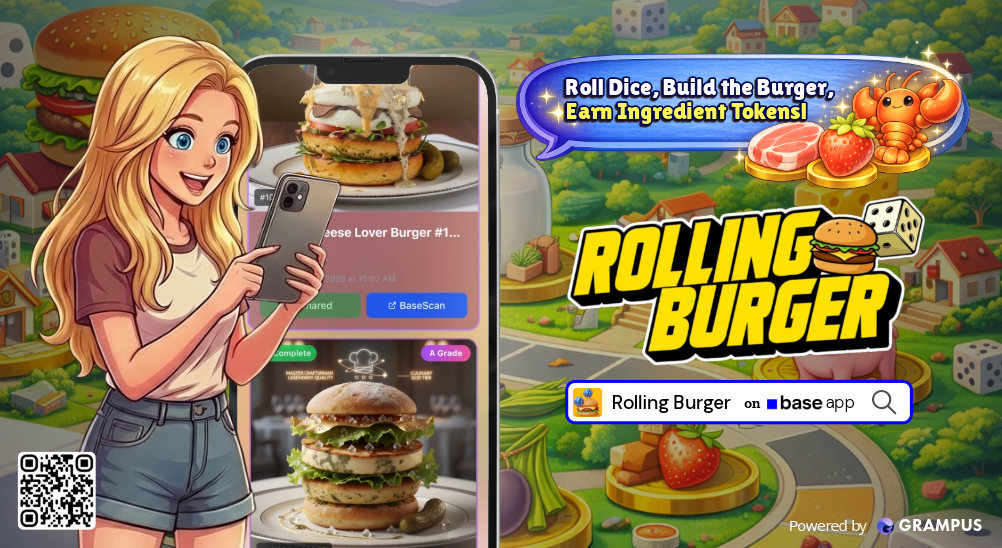
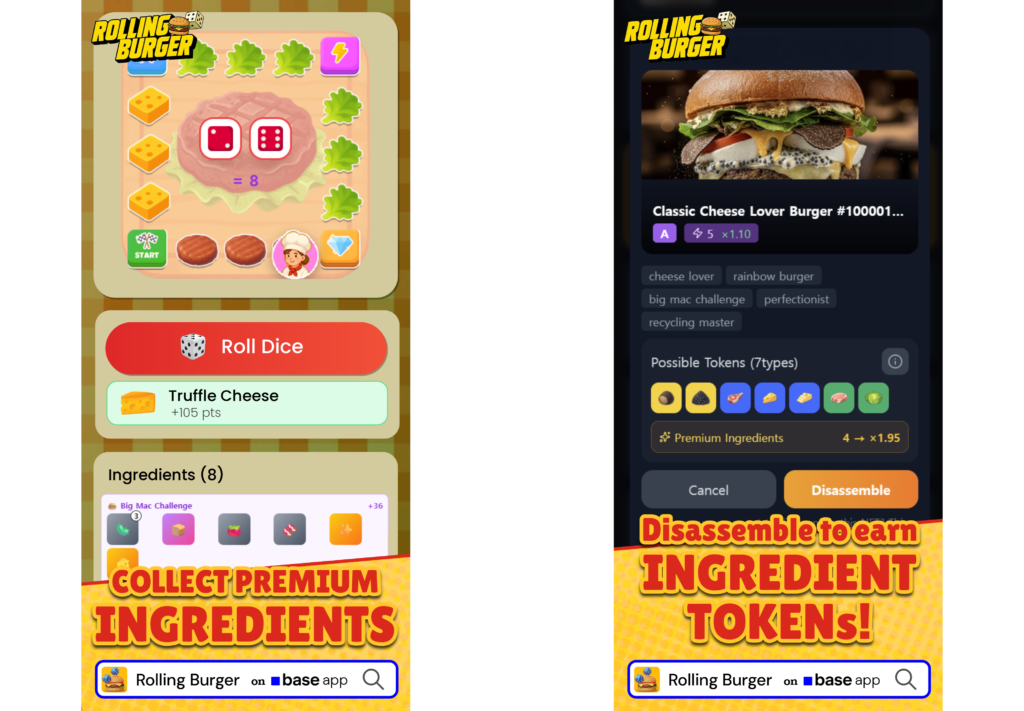
In Rolling Burger, players can break down burgers earned through play into ingredient tokens, and those assets aren’t locked to one game. The result of a session carries forward across the series and can even connect to broader cultural or market trends outside the game. For example, when K food gains global attention, a K food themed restaurant game can naturally emerge and drive demand for specific ingredients.
If demand for a gochujang token increases, players who specialized in gochujang burgers in Rolling Burger benefit directly from that shift.
This structure is possible because Chef Universe is built on top of the Base app. Players move across multiple series games using a single Base app account, and all 129 ingredient tokens can be held and traded under the same identity. Assets and progress aren’t fragmented by individual titles, but instead accumulate across the universe.
Ultimately, interoperability for us isn’t just about moving items between games. It’s about allowing value created inside a game to exist outside of it, where it can meet new participants, contexts, and demand. With tradable ingredient tokens at the center, the game economy and LTV are no longer capped by the lifecycle of a single title, but can continue to expand at the universe level on Base.
In this genre, success isn’t about difficulty but it’s about how the session feels and how players return. Do you find that the ‘ownership’ aspect (actually owning the dice or the resulting burgers on-chain) impacts retention?
In this genre, we tend to think about hybrid casual games through a hook, habit, hobby lens, and Rolling Burger is very deliberately designed to live in the hook stage. That’s why we built the core loop around dice. Every roll creates a different outcome, player choices shape the quality of the burger, and there’s always room for a surprise or reversal. All of that comes together to create a strong short session experience, which is what really matters early on. Our focus is on making each session feel fresh, lightweight, and emotionally complete on its own.
When it comes to retention, we don’t see ownership of the burger itself as the primary driver. What really shapes retention is the meta around ingredient tokens. Burgers are the immediate output of play, but ingredient tokens introduce longer term context, strategy, and anticipation. As players start to understand which ingredients matter, how demand shifts, and how those ingredients can be used or traded across the universe, that meta layer becomes the reason they come back. Ownership still matters, but more as an enabler of an evolving ingredient economy than as a standalone retention mechanic.
What are the most effective non-monetary ways you’ve found to acquire genuine users for a Base game today?
To acquire genuine users for a Base game without relying on monetary incentives, everything starts with structure. Rather than tokens or airdrops, the product needs to be designed from day one with visibility on the Base app and Farcaster in mind. Mini apps can surface repeatedly through rankings, picks, and featuring, so the real objective is to build something people naturally open, share, and come back to. That loop itself becomes the acquisition strategy.
This also means thinking about the social feed early. If result screens or shared images are not instantly understandable in a feed, users simply won’t click. Visual clarity and shareability aren’t marketing add-ons, they’re part of the core product, especially in the Base and Farcaster environment.
Community targeting is just as important. Farcaster has strong topic based channels, and posting everywhere at once rarely works. Choosing communities that match the intent of the app and tailoring the message to each channel consistently leads to much higher quality early users.
There are also lightweight ways to bootstrap attention inside the Base ecosystem. Tools like Amps or Surge can amplify early launch posts or support small scale exposure experiments at very low cost. This is less about advertising and more about quickly learning how the product resonates within an existing social graph, which is critical in the early validation phase.
Finally, working with Country Leads, Ambassadors, or game focused communities that are actively growing the Base ecosystem can be very effective. These groups often act as natural distribution hubs and help surface apps to users who are already aligned with the ecosystem. In Korea, for example, there is a dedicated Base game builder community called the Daehan Base Games Guild.
We are seeing a lot of discussion around ‘Agentic Commerce’ and the x402 protocol, which allows AI agents to handle payments without human intervention. How do you see this changing the monetization model for games on BASE? Specifically, do you think we will move away from subscriptions toward the ‘pay-as-you-go’ micro-payment models
Agent based x402 clearly makes micro payments easier, but using it in a way that actually fits games still needs more real world experimentation. Today, most AI agent use cases in games are focused on productivity or operational efficiency, rather than being woven into moment to moment gameplay.
Where it becomes compelling is around immersion and flow. Take Rolling Burger as an example. Players constantly face a small but emotional decision: do I roll the dice one more time, or stop now? An agent could make that call for the player, triggering a tiny payment only when the expected upside justifies it. That keeps the session smooth and uninterrupted, while preserving the underlying tension and strategy. In auto play RPGs, agents could step in only at key moments, like activating a temporary buff or retrying a failed encounter. In those scenarios, payment feels less like a transaction and more like a natural extension of automation.
Base is a strong environment to explore these ideas. With built in distribution, on chain payments, and lightweight mini app architecture, teams can test small experiments quickly and at low cost. Because of that, I expect some of the earliest and most practical examples of x402, agents, and gameplay mechanics coming together to emerge on Base.
Do you see similar ‘Web2-style’ UX hurdles we could notice on other chains, that Web3 developers need to overcome?
Base already removes many of the Web2 style UX hurdles that Web3 games still struggle with on other chains. Wallets, accounts, and payment flows are unified inside the Base app, so players can jump into a game without being constantly reminded that they are dealing with blockchain infrastructure. Treating games as discoverable, launchable apps rather than isolated dApps brings the experience much closer to what players already expect from Web2.
Because that foundation is in place, the builder’s focus naturally shifts. Instead of spending most of their energy reducing onboarding friction, teams can spend more time on a more fundamental question: how Web3 can actually expand the game experience itself.
That might mean making payments lighter and more contextual, or using AI agents to extend and automate parts of gameplay. In that sense, Base lets builders move beyond basic UX fixes and start experimenting with the bigger ideas shaping Web3, in ways that players can actually feel.
There are still challenges, of course. One of the remaining ones is how users initially on ramp assets. This isn’t unique to Base, it’s an industry wide issue closely tied to regulation across different regions. That said, it’s an area where shared standards and gradual improvements are already happening, and it’s likely to become less of a blocker over time.
The interview with John Hyukshin CHO highlights how the Base platform is enabling a fundamental shift in Web3 gaming from single-title economies to interconnected “Universes” like Chef Universe, overcoming Web2’s LTV constraints by making on-chain assets, such as ingredient tokens, transferable and central to long-term retention. By unifying UX on the Base app and focusing on an evolving ingredient-based economy over simple in-game ownership, the architecture supports continuous player engagement.