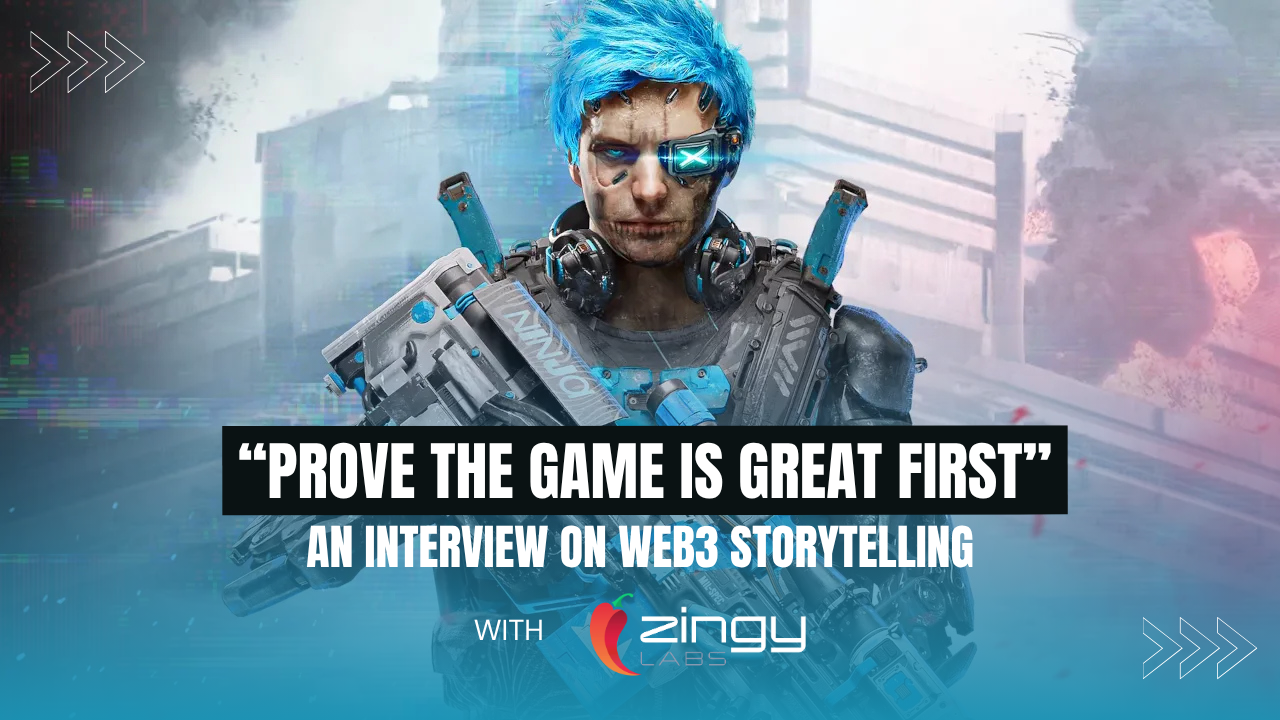
“Prove the game is great first.” An Interview with Zingy Labs
Zingy Labs on crossing the Web2/Web3 divide and the 5M-view campaign that did it
BGA sat down with Zingy Labs to unpack how the studio thinks about the chasm between traditional gamers and blockchain-native audiences. Their recent campaign for Off The Grid sailed past 5,000,000 views without leading with tokens or jargon. Here’s how they did it, what surprised them, and where they think AI and Web3 gaming go next.
For readers new to Zingy Labs: what problem do you solve and how did that shape the Off The Grid campaign?
Zingy Labs: Web3 games live between two worlds. On one side, you’ve got traditional players who care about fun and fairness; on the other, blockchain enthusiasts who care about ownership and value. Most campaigns treat those as separate universes. We don’t. Our job is to fix fragmented audience strategy and low-trust messaging.
For Off The Grid, we built a single, truthful narrative anchored in the game’s AAA craft and core loops. We showcased the experience first fast, visceral, readable gameplay and let ownership mechanics appear as an added benefit, not the headline. That fusion earned attention from both camps and helped push the campaign past five million views.
Pull-quote: “We proved the game was great first and let Web3 be the bonus.”
If you had to distill the playbook into three pillars, what are they?
Zingy Labs:
1) Audience Fusion, not Segmentation. One cohesive story that’s fun-first for the mass market, while quietly validating long-term ownership for the Web3 core. Move beyond the Web2/Web3 binary; sell the superior player experience.
2) Narrative-Driven KOLs. We prioritized creators who love the genre and can demonstrate skill and enjoyment on camera, not pure “crypto-fluencers.” Authenticity is the amplifier.
3) Real-Time Feedback Loops. 24/7 sentiment tracking and rapid iteration. When a content theme spikes, we double down; when a concern surfaces, we address it quickly and professionally. Strategy is a living system.
Everyone carries reputational risk : studios, players, token/NFT holders. How do you validate each without inviting backlash?
Zingy Labs: Radical transparency and value focus.
- Studios: Frame Web3 as optional, value-add tech. The product’s quality is the proof of commitment, no hype, no pressure to speculate.
- Players (Web2): Keep progression free, fair, and skill-based. Tackle “pay-to-win” fears head-on in the content.
- Web3 Stakeholders: Communicate utility and milestones consistently. Separate short-term speculation from long-term ecosystem participation.
Above all: never over-promise. Entertainment value leads the conversation.
Part of your audience cares about wallets and perks; others just want fun and fair progression. How do you design for both?
Zingy Labs: We use a Layered Content Architecture:
- Layer 1 — The Hook (≈90%): Pure gameplay, high-fidelity visuals, lore : the universal language of a great game.
- Layer 2 — The Bridge: Ownership ideas explained with familiar gamer terms (“rare drops,” “player-driven economy”), not blockchain jargon.
- Layer 3 — The Deep Dive: Targeted activations for the core Web3 crowd, with technical detail and “alpha,” kept to the right channels so the broader audience isn’t alienated.
This keeps the mass-market campaign clear and welcoming while still serving the on-chain faithful.
What turns a “gameplay beat” into a “social beat”? Has blockchain culture changed your checklist?
Zingy Labs: We translate features into feelings. A new weapon combo isn’t just “new”; it’s mastery, surprise, flow. Our internal checklist (which we share with partners) asks: What’s the human emotion? What’s visually legible in 3–7 seconds? Is there a skill moment? A narrative hook? A payoff? Blockchain adds a few new items like clarity around ownership or community rewards but the core is timeless: make it watchable, repeatable, and relatable.
Can engagement and community activations truly enhance retention in Web3 gaming?
Zingy Labs: More than in Web2. You still need updates, social connection, and progression but ownership adds a tangible reason to stay. Tokenized loyalty, DAO-style voting, and community quests with tradable rewards turn casual players into stakeholders. When players feel the ecosystem evolving and that they have a voice retention compounds.
How will AI change social ops for games over the next 12 months?
AI is going to move human teams up the value chain. Instead of grinding through asset resizing, captioning, or first-draft copy across ten platforms, your strategists will spend more time on positioning, taste, and creator relations. The machines handle speed (rapid copy variants, instant localization, and a steady flow of testable visuals) so a lean team can run a global schedule without losing coherence.
More interesting is what happens to judgment. We’re already seeing models that don’t just tag sentiment after the fact but anticipate where a post might backfire or where a theme could break out, giving you a chance to defuse a negative feedback loop before it forms or to double down on something that’s about to resonate.
On the front lines, autonomous agents will take over the repetitive ninety percent of community queries (links, how-tos, eligibility, patch timing) without pretending to be the community itself. That frees human managers to do the work that actually builds trust: acknowledging concerns, celebrating skill, and crafting the moments that feel personal rather than programmatic.
Start & Stop for Web3 studios ?
Stop – effective immediately:
- Leading with tokenomics. It attracts speculators and alienates gamers. Lead with fun.
- Over-promising “revolutions.” The trust deficit is real. Be specific and let the product speak.
Friction-heavy onboarding. Make crypto optional; get people playing instantly.
Start – looking to 2026:
- AI-powered personalization. Rewards, challenges, ownership opportunities that feel tailored, not mandatory.
Community-as-a-Product. Treat community as a core feature with transparent, verifiable governance.
Cross-chain by design. Build for interoperability to maximize liquidity and asset utility.
Final word from Zingy Labs: If you want both audiences, earn them the same way: show the game. Then let ownership feel like a natural extension of a world players already love.

Recent Posts