
An article led by Álvaro Herráez González, On-Chain Intelligence Ana for BGA
Part 1: Macro Liquidity (M2) Dynamics and Stablecoin Treasury Architecture in Web3 iGaming
Contributor: Álvaro Herráez González | On-Chain Intelligence & AML Specialist
Methodology: Cross-chain supply and bridge telemetry via Artemis Terminal.
Data Context: Macro trends consolidated in July 2026.
Summary
As operators adapt to the fully enforced MiCA regulatory guidelines in 2026, corporate treasury management must evolve past static capital placement. Global contractions in the M2 money supply dictate sharp shifts in user liquidity allocation, directly triggering sudden liquidity and withdrawal stress across digital platforms. This technical contribution outlines the structural requirements to decouple front-end user execution layers from institutionalgrade settlement vaults, protecting operational reserves and ensuring payout finality during macroeconomic dry-spells.
To implement this structural decoupling, this analysis leverages advanced on-chain analytics data to establish a proactive, real-time risk management framework. By introducing a standardized four-tier metric matrix—encompassing deposit elasticity coefficients (MDEC), treasury decoupling ratios (TDR), exit friction indices (EFI), and capital flight velocity triggers (MTTM)—operators can programmatically monitor network anomalies and automate the sweeping of operational cash flows. This algorithmic approach permanently eliminates manual audit latency and retrospective review errors, enabling corporate structures to mirror institutional smart money behavior and actively secure uncompromised solvency buffers on deep settlement networks before secondary rails suffer systemic fragmentation.
I. The M2 Transmission Mechanism
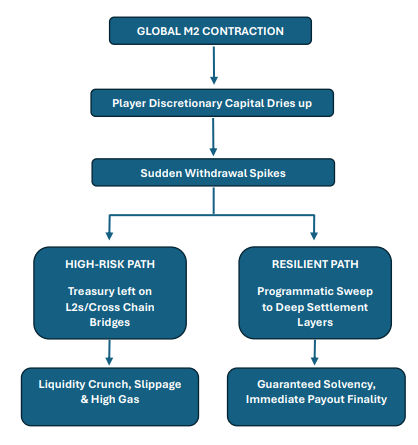
The global M2 money supply is the ultimate macro indicator of consumer discretionary capital. In Web3 iGaming, the transmission mechanism is direct. Capital velocity spikes, increasing organic deposit inflows and stabilizing operational liquidity buffers on GambleFi platforms. Central bank tightening shrinks retail discretionary spend. This causes player deposits to experience sharp seasonal slowdowns, typically accompanied by sudden, unpredictable spikes in user withdrawal requests. For an iGaming platform, this structural shift tests the core operational solvency of their treasury architecture.
II. Stablecoin Collateral Asymmetry
To withstand these contractionary macro cycles, operators must align their backend architecture with institutional smart money behavior rather than media hype.
As demonstrated in Figure 1 (Stablecoin Supply by Token & Chain), the global stablecoin base remains highly mature and stable between $310B and $320B, heavily dominated by the USDT (green) and USDC (blue) duopoly.
| Figure 1: KEY METRICS |
| Global Stablecoin Base: $310B – $320B (USDT/USDC Dominated) Core Settlement Vaults: Ethereum & TRON (>80% Sourcing) High-Speed Execution: Solana & Base (<5% Aggregate Supply) |
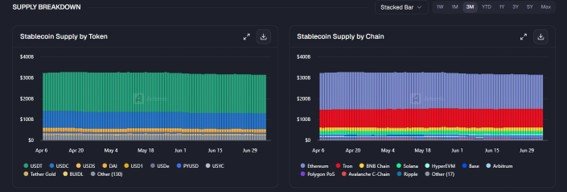
The critical forensic insight from Figure 1 lies in the chain distribution: Ethereum (purple) and TRON (red) securely custody more than 80% of all global dollar-pegged liquidity. In stark contrast, high-speed execution layers like Solana or Base, while processing massive daily transacting noise, hold a remarkably thin slice of the aggregate stablecoin supply.
III. Strategic Treasury Action for 2026 Operators
During macro dry-spells, market makers rapidly pull liquidity out of cross-chain bridges and dynamic decentralized pools to mitigate risk. If an iGaming operator leaves its corporate reserves floating entirely on secondary L2s or high-speed rails, it faces immediate exitfriction, aggressive slippage, and volatile gas fees when liquidating corporate assets to cover sudden player withdrawal rushes.
Front-end user deposits should natively run on low-fee execution networks like Solana or Base to eliminate onboarding friction and enhance the overall user experience for retail players. Meanwhile, the backend corporate infrastructure must implement automated, programmatic sweeping pipelines designed for instant risk mitigation. Under this architecture, net operational revenues are automatically redirected from high-frequency layers and securely locked into institutional-grade settlement vaults on TRON or Ethereum, effectively guaranteeing absolute solvency, deep capital reserves, and immediate payout finality under any adverse macro financial climate.
IV. Key Metrics: Macro-M2 Risk Indicators for iGaming Treasuries
To operationalize this macro framework, operators and auditors should monitor three core Key Performance Indicators (KPIs) to assess treasury resilience against global liquidity shifts:
1. M2-to-Deposit Elasticity Coefficient (MDEC)
It measures the sensitivity of players’ organic deposit volumes in relation to 30-day percentage changes in global M2 liquidity aggregates.
An MDEC > 1.5 during contractionary phases indicates that the platform’s user base is highly exposed to macroeconomic liquidity dry-spells. This requires an immediate increase in the platform’s stablecoin reserve buffers.
2. Treasury Decoupling Ratio (TDR)

Operators should maintain a TDR minimum of 4:1. This ensures that 80% of corporate capital is fully insulated from bridge exploits, exit-friction, and slippage during severe market contractions, matching the institutional distribution baseline visible in Figure 1.
3. Layer Exit Friction Index (EFI)
What it measures: The aggregate percentage loss derived from gas price spikes, slippage, and automated market maker (AMM) imbalance when liquidating $100K blocks of execution-layer collateral during sudden withdrawal spikes.
An Execution Layer Exit Friction Index (EFI) above 2.5% indicates dangerous fragmentation in secondary networks during mass withdrawals, triggering an automated sweep order to reallocate funds to primary liquidation vaults. This mechanism protects corporate treasury by halting high-risk allocations and consolidating capital in highly liquid networks like Ethereum or TRON in the face of structural instability.
4. Treasury MTTM (Mean Time to Move) & Liquidity Velocity Factor (LVF)
It shows us the precise operating time interval required by smart contracts or automated protocol scripts to execute a complete capital flight, taking floating revenues out of highrisk execution layers and depositing them into primary liquidation vaults during a systemic liquidity crisis.
A MTTM exceeding 180 seconds under heavy network congestion flags an architectural failure. If exit-friction spikes and the node cannot clear transactions within this 3-minute window, the protocol faces an exponential pool imbalance. To mitigate this tail risk, the engine automatically adjusts the slippage parameters and switches from single-bridge routing to a multi-path split protocol, ensuring immediate capital preservation.
V. Conclusion: The Decoupling of Execution and Capital Preservation
The macroeconomic situation in 2026 necessitates a review of risk models. Contractions in the M2 money supply demonstrate which platforms have a stable model and which depend on pure retail speculation. In Web3 iGaming, brand equity depends entirely on instant payout finality and immediate withdrawal liquidity. Decoupling on-chain execution from operational reserves establishes an immediate solvency buffer. This structural separation insulates funds against bridge incidents or network congestion, ensuring business viability during periods of global low liquidity.