
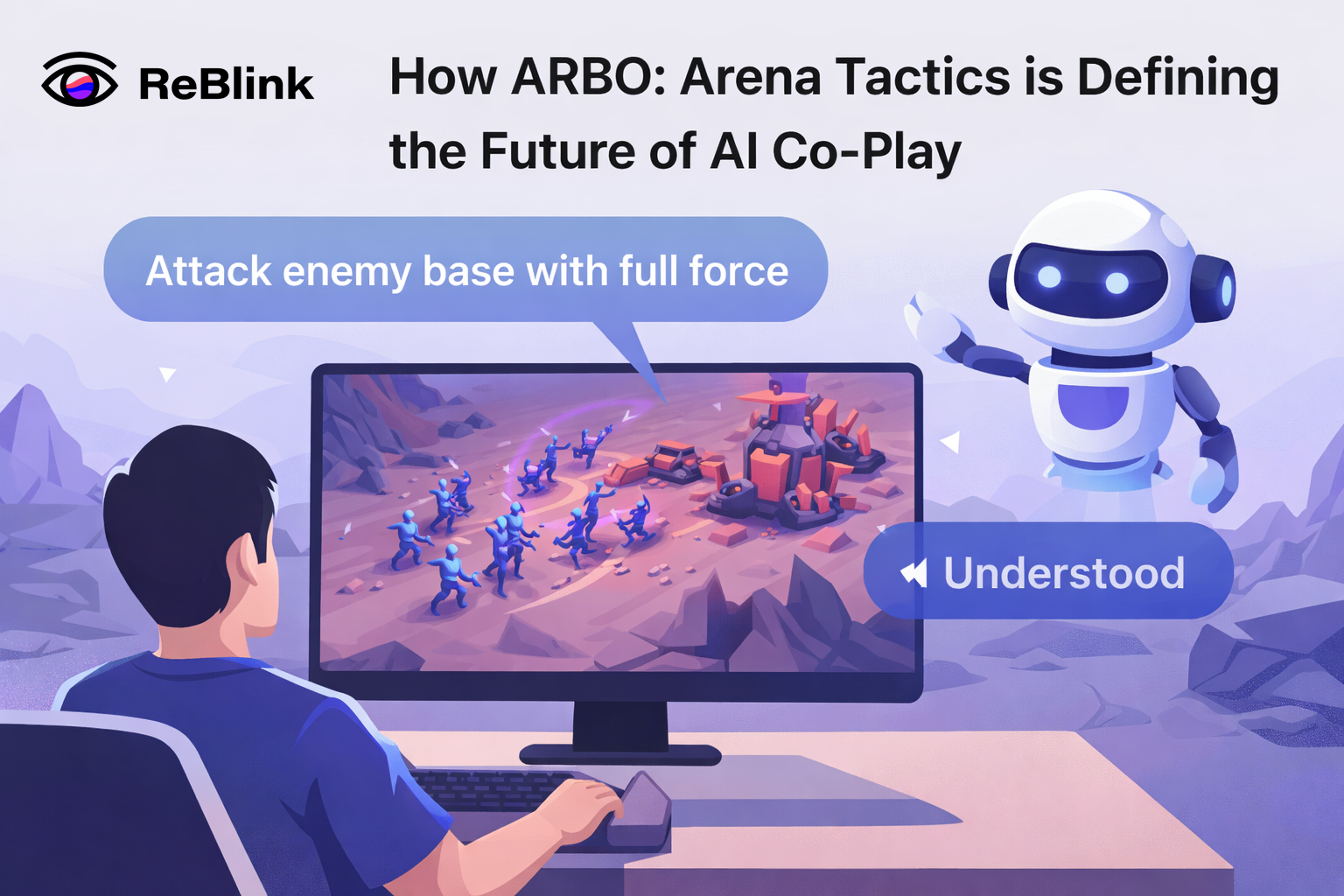
How ARBO: Arena Tactics is Defining the Future of AI Co-Play
In a strategy landscape often defined by high skill floors and complex system mastery, ARBO: Arena Tactics is pioneering a new form of gameplay: the hybrid-play experience. It empowers players to act as a Commander, issuing natural-language instructions while the AI handles execution, dramatically widening accessibility to the deep-mechanics strategy genre.
In this exclusive interview, we speak with Aru Sri to delve into the core design philosophy of ReBlink’s innovative title. We explore the frustration that led to “Language should be the control surface,” what constitutes a “good command,” the fine line drawn between player intent and AI interpretation, and the long-term vision for ARBO: Arena Tactics to define the future of AI co-play in games.
In one line: what new player fantasy does ARBO: Arena Tactics unlock that other strategy games can’t?
Arena Tactics lowers the traditional strategy “skill floor” by letting players act as a Commander who issues natural-language instructions while the AI handles execution, creating a hybrid-play experience accessible to both core and casual players.
In one line: what new player fantasy does ARBO: Arena Tactics unlock that other strategy games can’t?
Traditional tactics games require deep system mastery, which limits the addressable market. Auto-battlers simplify too far; complex tactics games demand too much. Using language as the control mechanic lets us keep depth while dramatically widening accessibility—opening the genre to casual and hybrid-casual players.
What does a “good command” look like in ARBO: Arena Tactics (structure, context, brevity)? How do you teach that without turning the game into a prompt tutor?
The great thing about Arena Tactics is that a player, regardless of their experience with games like ours, can get entertainment value with the simplest of commands. Much like the first experience people have with ChatGPT where a prompt may have been simple, players can start with simple commands and learn how the AI responds and alter their commands.
Much like Prompt Engineering, the best commands are clear about the objective, aim to reduce inconsistencies or redundancies, provide clear instructions and are nuanced in specifying constraints or details for execution.
Example of great commands:
- “Use the Specter to create a Noxious Mine adjacent to the Enemy Base as soon as possible. The Squad shall not use any other Protocols until the Noxious Mine is placed.”
- “Use Specter to collect closest Cache, then have the Specter create a Noxious Mine adjacent to Enemy Base as soon as possible. If out of range, spend all MP to close distance first. The Squad shall not use any other Protocols until the Noxious Mine is placed. The other two reavers must play normally, focusing on attacking the enemy heroes.”
- Example of basic commands that deliver immediate entertainment value:
- “Retreat to our home base and play defensively”
- “All units to the enemy base and destroy it”
Where have you drawn the line between player intent and AI interpretation to avoid “the game playing itself”?
The experience in Arena Tactics strikes a balance between two extremes: the open-endedness of ChatGPT, where prompt quality and context can drastically affect results, and the precision of a purpose-built deterministic AI. While our system leans closer to the former, it is tuned specifically to our game mechanics, ensuring that the AI’s decisions remain contextually relevant.
The AI plays the deck the player builds, guided by the initial instruction set defined during deckbuilding, always working toward the player’s goal of winning within that framework. However, during gameplay, player prompts may not always align with the current game state, in which case the AI interprets them as best it can within its constraints.
This mode allows players to choose their level of involvement, from fully automated play where the AI executes strategies defined during deckbuilding, to active in-game command and control. While the system supports both styles, most players choose to issue commands mid-game to influence outcomes directly.
Who benefits most from language control—newcomers, controller users, or neurodiverse players?
Newcomers, neurodiverse and non-core players of the genre benefit most with language control, as it provides low barriers to entry to enjoying the limitless entertainment value of deep mechanics strategy games like Arena Tactics.
The language control also allows core strategy players an alternate game mode to battle test their decks in quick games and engage in economy mechanics that allow them to maximize their resource gathering to enhance their goals in the traditional game mode.
What are the key supervision signals you capture (command → plan → micro-actions → outcome) to improve future inference?
Our primary objective is to produce rights‑clean, structured gameplay telemetry at scale. So we capture high-fidelity, temporally aligned action-state data. Every action, from a move, using an ability, casting a card, and even ending a turn, is all valuable action data, when paired with the resulting state, allows us to improve the performance of the AI but also provides valuable insights for game design.

Tags
Recent Posts

Senior QA at DeGaming
Product Owner at DeGaming