We are rapidly approaching the limit of what legacy financial stacks can handle in modern gaming. We have constructed hyper-realistic, persistent digital worlds, yet we are powering their internal economies with banking infrastructure from the 1970s.
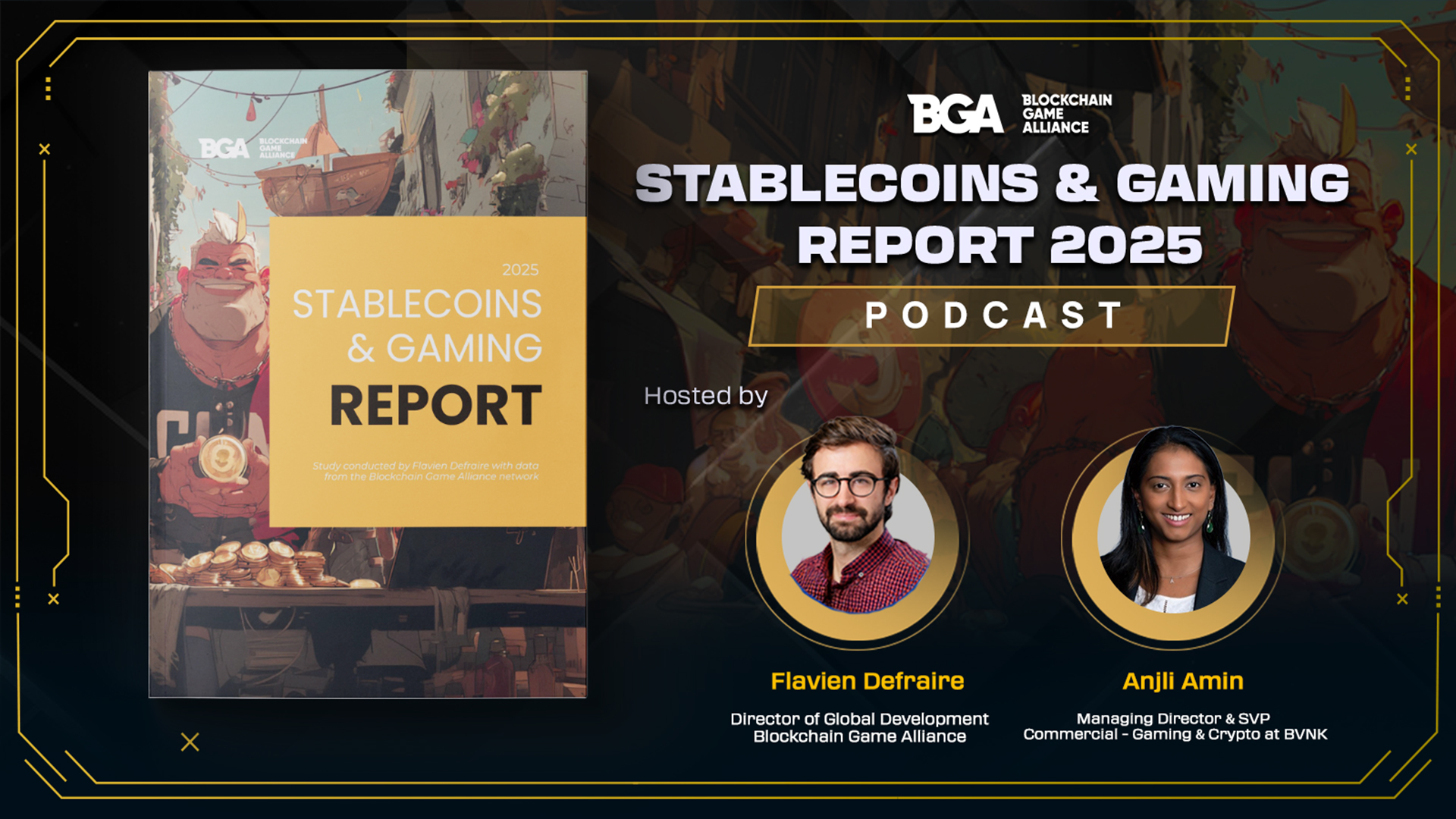
On a recent episode of the Blockchain Game Alliance podcast, host Flav sat down with Anjli Amin, Head of Growth for Europe at OpenFX, to discuss the friction between traditional finance and the digital asset space. Their deep dive into the cross-border payout nightmare illuminated exactly how stablecoins are quietly rewriting the backend architecture of global gaming.
Here is the system diagnostic on why traditional payment rails are failing, and how the industry is deploying a critical infrastructure patch:
1. The One-to-Many Routing Error
E-commerce solved the “many-to-one” pay-in pipeline ages ago via standardized APIs and dominant merchant acquirers. But paying creators out is a fragmented, “one-to-many” logistical nightmare. When a studio tries to route funds globally, they are forced onto antiquated SWIFT networks that act like analog toll roads. A single payment might bounce through three or four correspondent banks, bleeding value to FX fees at every single hop.
Did you miss the other episodes of the podcast “Stablecoins in Gaming” ?
2. The UGC Bottleneck
We are watching games pivot into massive creator economies. Top-tier titles like Roblox and Fortnite have formalized programs allowing developers to convert digital tokens into fiat. The scale is staggering—the top one thousand developers are pulling in an average of one billion dollars annually. Yet, getting that capital from the studio’s treasury into a creator’s local bank account across borders is rife with operational friction and margin-eroding fees.
3. Executing the “Stablecoin Sandwich”
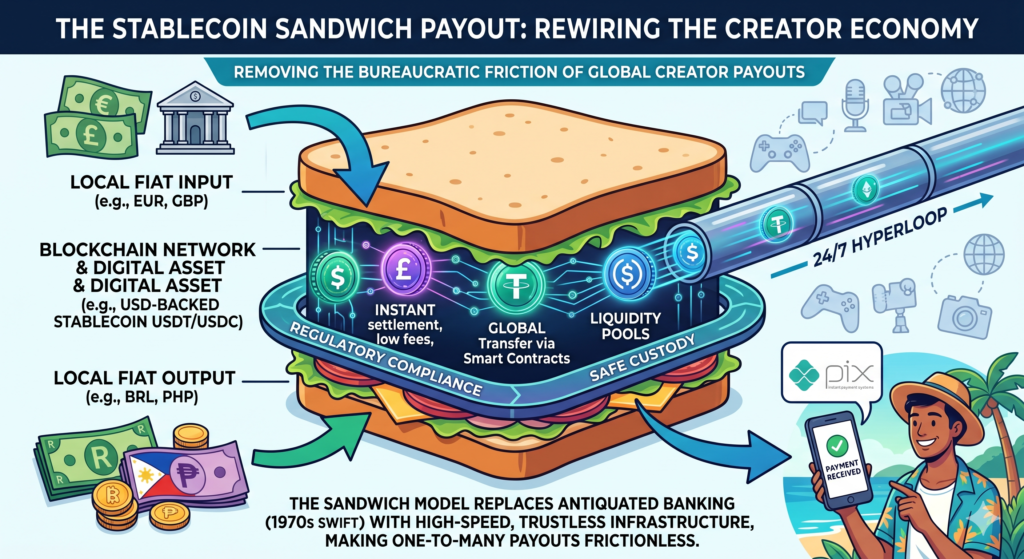
To fix the latency of cross-border payouts, infrastructure builders are deploying what OpenFX refers to as the “stablecoin sandwich”.
- Instead of navigating a string of intermediary banks, studios convert local fiat into stablecoins.
- These digital assets are fired across a 24/7 blockchain rail, acting as a high-speed hyperloop for capital.
- On the receiving end, the stablecoin is converted back into local fiat and deposited via instant regional networks, like Brazil’s PIX system.
4. Treasury Optimization & The Ping-Rate of Capital
It isn’t just about paying users; corporate treasury management is suffering from massive lag. Moving internal corporate funds between regions like Europe and Brazil can take three to five days. That is dead time where capital generates zero yield. Even massive traditional institutions are recognizing this backend flaw, with Credit Agricole recently moving to issue their own stablecoins specifically for internal treasury optimization.
5. Escaping the Dollarization Default
For this tech stack to achieve global equilibrium, it needs to expand beyond the US dollar. Currently, a massive 98% of stablecoins are pegged directly to the dollar. This forces an unnecessary layer of FX conversion upon global ecosystems. For seamless adoption, especially in regulated markets like Europe, the infrastructure requires deep liquidity pools of native, privately-backed Euro and Sterling stablecoins.
The Bottom Line The ultimate benchmark for any foundational technology is absolute invisibility. The consumer shouldn’t care about the blockchain protocols executing in the background, much like we don’t care how the power grid routes electricity when we flip a light switch. By leveraging stablecoins as a frictionless, borderless settlement rail, we are finally upgrading the gaming industry’s financial backend to match the speed of its software.
iGaming & Web3 Glossary: Key Concepts
- Stablecoin Sandwich: A routing methodology where fiat is converted to a stablecoin for international transport, then immediately converted back to local fiat at the destination.
- One-to-Many Payouts: A complex backend financial flow where a single corporate entity must distribute funds to thousands of individual users across varying international jurisdictions.
- On/Off Ramping: The architectural infrastructure required to move capital between traditional fiat banking systems and blockchain-based digital asset networks.
- Treasury Optimization: The strategic, rapid movement of internal corporate capital across borders to maximize efficiency and avoid the dead-time associated with legacy banking.